
Insights
Smarter Goals and Why They Matter
March 20, 2026 · 8 min
Whenever I wanted to accomplish something in my life, I would start with a simple sentence in my head.
“I will learn Korean.”
“I will become a 3D designer.”
Big goals. The kind that feel exciting just thinking about them. And honestly, at the beginning, I always enjoyed it. I liked learning, I liked the idea of becoming better, I liked imagining the end result. But most of these lasted about a month. Not because I didn’t care. And not because I didn’t enjoy the process. But because I didn’t have anything in place to keep me going.
Life happened, something more important came up, motivation slowly faded, and eventually I just stopped.
I didn’t fully give up on these goals either. They just stayed in the background as something I “might return to one day”.
But some goals actually worked
This is the part that confused me for a long time. Because there are things I did manage to accomplish.
- I became a graphic designer.
- I became a frontend developer.
- I even started building something that looks like a business after sitting on the idea for years.
So clearly, I can follow through. Which made me question:
Why did these work, while others, like learning Korean, never really moved forward?
It wasn’t motivation. It was priority.
At first, I thought it was discipline. Or consistency. Or just “wanting it more”. But that wasn’t really true. The real difference was much simpler, and also a bit uncomfortable to admit. It was priority.
All of our goals come from things we value.
- If you value knowledge, you’ll want to learn.
- If you value stability, you’ll focus on career.
- If you value connection, your goals will reflect that too.
I’ve always been someone who enjoys learning. That’s why things like learning Korean felt natural to me. But here’s what I didn’t realize back then:
Just because something aligns with your values doesn’t mean it’s your top priority.
At that point in my life, financial independence was more important. Not because I didn’t care about learning anymore, but because it felt more urgent. More necessary. And when one value becomes more important than the others, your behavior follows that, whether you consciously decide it or not.
Why some goals take over your life
Learning design and frontend development also required learning, just like Korean. But they were directly tied to something I needed. So they became harder to ignore.
They weren’t just “nice to have”. They were necessary. And that alone changes how you approach them.
- You don’t negotiate with them as much.
- You don’t postpone them as easily.
- You don’t drop them the moment something else comes up.
The part I completely overlooked
There was another difference, and this one is even more important. Those goals had structure. I didn’t just randomly decide to learn design. I went to school for it.
Which meant:
- there was a schedule
- there were expectations
- there were deadlines
- there were consequences
I had classes every day. I had assignments. I had tests. Even if I didn’t feel like doing it, I still showed up. And that created consistency without me having to rely on motivation.
What was missing from my other goals
When I tried to learn Korean, none of that existed.
- There was no plan.
- No structure.
- No checkpoints.
So every day started with the same question: “What should I do today?”
And that question alone was enough to stop me. Because if something else came up, something more urgent, I would just switch to that. Not because I didn’t care. But because this goal didn’t have anything holding it in place.
So how do we fix this?
This is where things started to click for me. The problem wasn’t that I couldn’t achieve these goals. The problem was that I never turned them into something I could actually follow. So instead of relying on motivation, I started looking for a way to define goals more clearly.
That’s where the SMARTER framework comes in.
Turning a vague idea into something real
Let’s go back to the original goal:
“I want to speak Korean.”
This sounds like a goal, but if you think about it for a moment, it’s actually very unclear. What does “speaking Korean” really mean?
- Is it being able to introduce yourself?
- Hold a casual conversation?
- Understand everything fluently?
Without defining that, your brain doesn’t know what to aim for. And when there’s no clear target, it becomes very easy to lose direction or feel like you’re not making progress, even if you are.
This is where the SMARTER framework helps. Not because it’s perfect, but because it forces you to slow down and actually think through what you’re trying to achieve.
Making the goal concrete (Specific + Measurable)
The first step is to turn your idea into something you can actually picture happening in real life. Instead of saying:
“I want to speak Korean”
You define it as something observable:
Have a real-time conversation in Korean with another person.
Now you can imagine the situation. You can see yourself in it. But even that can still feel a bit open-ended. So the next step is to define what success looks like in a way that you can clearly measure.
For example:
Have a 10-minute conversation without switching to English.
This is where things start to feel different. You’re no longer relying on a vague sense of improvement. You’re not asking yourself “am I getting better?”
You’re asking:
“Did I do it?”
And that shift is important, because it removes uncertainty. It gives you something concrete to work toward, and something clear to evaluate when you get there.
Making it something you can actually follow (Achievable + Relevant)
This is the part that’s easy to skip, but it’s usually where things fall apart. It’s very tempting to define goals that sound impressive, but are not realistic for your current situation. So instead of asking “what would be ideal?”, you need to ask:
What can I realistically follow through on right now?
- Maybe 10 minutes is too much at the beginning.
- Maybe 5 minutes makes more sense.
- Maybe the conversation should be limited to a specific topic first, like introducing yourself or talking about your daily routine.
This is not about lowering your standards or making the goal “easier”. It’s about creating a version of the goal that you can actually build momentum with. Because a smaller goal that you consistently work on will always take you further than a perfect goal that you avoid starting.
This is also where relevance comes in. You need to be honest with yourself:
Is this goal important enough right now compared to everything else in your life?
Because if it’s not, that doesn’t mean you should drop it, but it does mean you need to adjust your expectations and your pace.
Giving it direction (Time-bound)
Without a timeframe, goals tend to stay in your head indefinitely. They become something you’ll “get to eventually”, which usually means you won’t. So you give it a boundary:
Within 8 weeks.
Now there’s a sense of movement. There’s a reason to show up consistently. You’re no longer just “learning Korean”. You’re working toward something that has an endpoint. And that changes how you approach it on a daily basis.
What this actually gives you
When you put all of this together, your goal becomes:
Have a 10-minute conversation in Korean with a native speaker, on a specific topic, staying fully in Korean, within 8 weeks.
Compared to where we started, this is completely different. It’s clear. It’s specific. It’s something you can act on.
The part that actually keeps you going (Evaluate + Reward)
This is the part that most people ignore, but it’s also the part that makes the biggest difference over time. Even with a well-defined goal, things won’t go perfectly.
- You’ll have days where you don’t feel like doing it.
- You’ll miss sessions.
- You’ll feel like you’re not improving fast enough.
And if you don’t have a way to deal with that, it’s very easy to slowly drift away from the goal. That’s where evaluation comes in. Instead of waiting until the end, you check in with yourself regularly.
You ask:
- Am I actually making progress?
- Is this plan still working for me?
- Do I need to adjust anything?
These moments of reflection are important, because they allow you to correct your direction early, before frustration builds up enough to make you quit. It also helps to define smaller checkpoints or milestones along the way, so you’re not working toward something far away without any sense of progress.
And then there’s something that might feel small, but is actually very powerful: rewarding yourself. When we think about progress, we usually focus on results. But consistency is just as important. Showing up, even when it’s not perfect, is what builds momentum. So instead of only rewarding the final outcome, you give yourself credit for the process as well.
That could be something simple:
- taking a break without guilt
- doing something you enjoy
- acknowledging that you stayed consistent
These small rewards reinforce the behavior you want to keep. And over time, that makes it much easier to continue, especially during the phases where motivation is low.
Build a system, not just a goal
Even with a well-defined goal, nothing happens without action. This is where most people stop, they define a goal and expect it to somehow work on its own. But what actually moves things forward is the system behind it.
- What are you doing daily?
- What are you doing weekly?
- What does progress look like in practice?
When you remove the need to constantly decide what to do next, everything becomes easier. You don’t rely on motivation anymore, you rely on structure.
And one last thing
Things will go wrong.
- You’ll skip days.
- You’ll lose momentum.
- Something unexpected will come up.
That doesn’t mean the goal failed. It just means you need to adjust.
If you want help with this
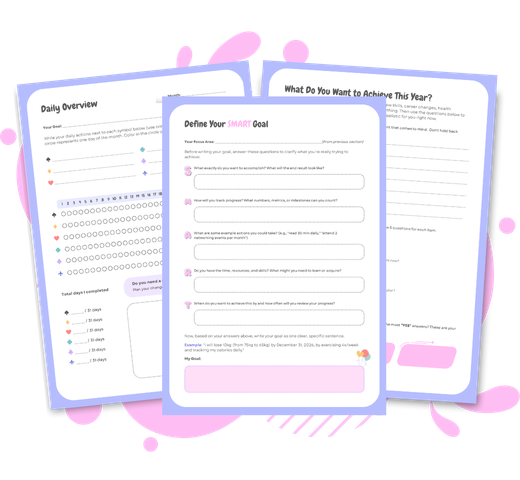
I created a printable workbook that helps you go through this whole process step by step.
It covers:
- defining your values
- structuring your goals
- creating action plans
- tracking progress
- reflecting and adjusting
If you feel like you need more structure, it can help guide you through it.
This is something I’m still figuring out myself, but understanding this difference already changed how I approach goals.
And I’ll definitely share more about it as I go.